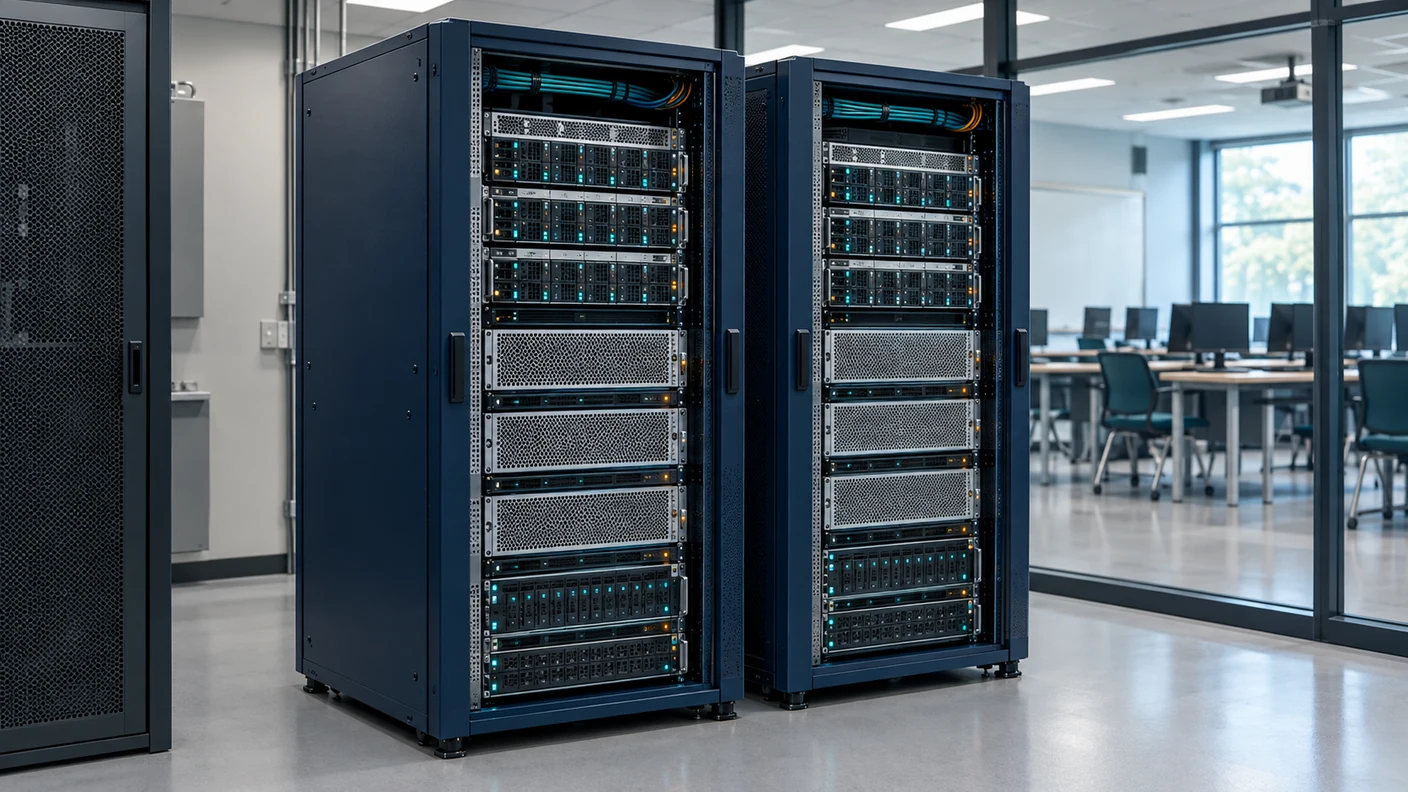

A cooperative GPU network, as we use the term at Civic Compute, is a group of participating institutions coordinating access to GPU capacity under agreed technical, operating, and economic rules. The aim is to make local infrastructure more useful while preserving each institution's authority over participation.
Think of a proposed arrangement between two colleges. One has a busy afternoon lab schedule; another has a different teaching calendar and a research workload that can run overnight. Before either buys additional capacity, the institutions could evaluate whether some approved work can use the other's available resources.
That example is an operating concept, not evidence of guaranteed savings. A useful network needs more than idle GPUs: it needs compatible workloads, clear rules, accountable operators, and permission to share.
What a cooperative GPU network should coordinate
We recommend separating ownership from coordination. A college should be able to understand which equipment it owns, which services it licenses, which workloads it authorizes, and what obligations come with network participation.
Civic Compute describes 3COL as a licensed management layer for GPU access, scheduling, and usage tracking. (3COL platform overview) For any proposed deployment, put hardware ownership and operating responsibilities in the agreement rather than assuming that network participation transfers ownership.
A sound participation design should answer four questions:
- Access: Which users and workloads may consume capacity, and which must remain local?
- Priority: How will coursework and other institutional commitments be protected?
- Accountability: Which usage records support reports, charges, and dispute review?
- Governance: Who may change participation terms, pricing, or operating policy?
For example, a college could propose reserving specific teaching windows and offering only approved off-hours capacity. Whether that arrangement is appropriate depends on the workload, the funding source, and the institution's own policies.
Why colleges might benefit
The strongest reason to evaluate a cooperative is not “our GPUs will pay for themselves.” It is the possibility of coordinating capacity and operating practices around the institution's educational mission.
We suggest assessing three potential benefits:
- More useful access: Could approved work run at another site when local resources are unavailable, rather than being delayed or cancelled?
- Shared operating practice: Could members reuse onboarding checklists, support procedures, and instructional deployment patterns?
- A possible contribution to costs: Could permitted outside demand generate receipts that help offset part of the host's operating expense?
Treat each benefit as a hypothesis to test. A pilot should show whether compatible work exists, whether the user experience is acceptable, and whether the support effort makes the arrangement worthwhile.
Civic Compute's platform overview describes cross-site job routing, usage reporting, and cooperative revenue accounting as part of its platform approach. Use those capabilities as discussion points for a defined deployment scope, not as a substitute for an institution-specific agreement.
A network is not one giant GPU server
An important technical distinction is where a job runs. Slurm federation lets eligible clusters independently attempt to schedule copies of a submitted job; when one starts it, the other copies are revoked. (Slurm federation guide)
That model is different from promising that a single training run can automatically combine GPU memory from colleges in different locations. In planning discussions, distinguish “this job can run at another approved site” from “this job can use every GPU in the network at once.”
Ask the technical team to validate the following before promising access:
- Workload compatibility: Required GPU capacity, software environment, and model dependencies.
- Data placement: Where inputs, outputs, logs, and backups will reside.
- Transfer practicality: Whether moving approved data is appropriate for the job.
- Failure behavior: Who handles retries, failed transfers, and abandoned outputs.
- Local restrictions: Which workloads must never leave the host institution.
A small, well-defined network is a better starting point than a broad promise that any workload can run anywhere.
Protect instructional access before opening spare capacity
Begin with the college's teaching calendar and service commitments. Agree on the capacity that must remain available for classes, the workloads eligible for sharing, and the process for suspending outside access.
For example, a policy might keep a lab's teaching allocation unavailable to outside work during class hours. Another might permit only short jobs in the hours before a scheduled course, avoiding a promise to interrupt long-running work unless safe interruption and recovery have actually been tested.
Require an acceptance test that creates competing demand. The institution should see how the policy behaves during a busy class period, not just how the platform behaves when the cluster is empty.
Keep revenue expectations separate from cost commitments
Prepare the operating budget without assuming that every unused hour will be sold. Then evaluate potential outside receipts as a separate scenario, using explicitly stated assumptions about demand, permitted rates, utilization, and the applicable agreement.
The financial review should distinguish:
- Gross receipts: What is actually collected for eligible work.
- Distribution rules: How the agreement allocates those receipts.
- Incremental costs: Additional power, support, payment, and data-transfer costs.
- Continuing obligations: Hardware maintenance, licensing, and staff responsibilities that remain even when outside demand is low.
Also settle who approves adjustments and how a host challenges a statement. Slurm can provide job and resource-use records, but those records still need to be connected to the network's financial rules. (Slurm accounting documentation)
Grant-funded equipment needs a separate review
Shared capacity does not automatically mean unrestricted commercial capacity. Where the relevant federal equipment provisions apply, outside use must not interfere with the original project, and fee-based services are subject to restrictions while the federal government retains an interest in the equipment. (2 CFR § 200.313(c))
The same regulation distinguishes the requirements for States, Indian Tribes, and other recipients or subrecipients. (2 CFR § 200.313(a)–(b)) Ask the grants office and legal team to review institutional status, award conditions, program income, and outside-use permissions before including grant-funded equipment in a revenue plan.
Treat this as an approval gate rather than a footnote. Civic Compute's grant application consulting services can help frame the funding discussion, while the institution and relevant authorities determine what the award permits.
Evaluate control as carefully as connectivity
A participation agreement should specify data-location choices, administrative access, retention, incident responsibilities, pricing authority, and withdrawal procedures. Do not accept “sovereign” as a complete security specification; ask the operator to explain what stays local and what information reaches shared management services.
Start with a limited pilot and written success criteria. If the college can protect instruction, account for approved usage, support the workflow, and leave the arrangement on understood terms, it has a practical basis for considering wider participation.
Explore a cooperative GPU deployment with Civic Compute. We recommend starting with your teaching schedule, capacity needs, and participation constraints before estimating potential financial returns.
About the Author

Dan Golden, CSPO, MIT
Co-Founder & Partner, Engineering & Infrastructure
With over 30 years of experience in enterprise software design, implementation, management, and consulting, Dan is responsible for platform architecture, software infrastructure, and technical product leadership for the 3COL suite of applications. Dan has a Master of Information Technology from American Intercontinental University and is a Doctoral Candidate of Business Administration at Salem University. (About Civic Compute)